

SunSirs: China Unveils First Oilfield to Store Over 1 Million Tons of CO₂ Each Year
December 30 2025 15:32:13 China Geological Survey (lkhu)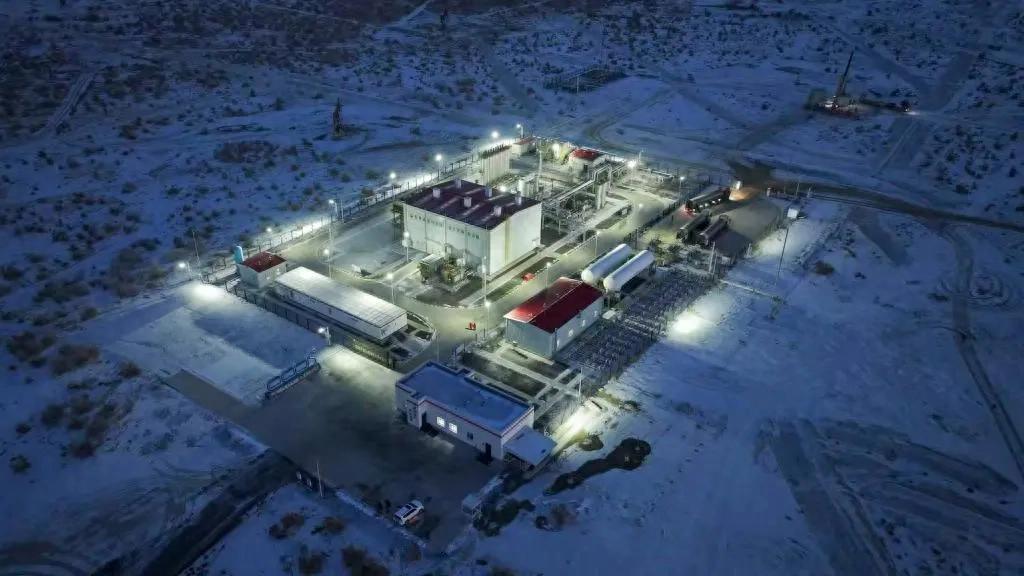
China National Petroleum Corporation announced on December 29 that, as of December 28, the amount of carbon dioxide injected into the Xinjiang Oilfield this year has exceeded 1 million tons, making it the first oilfield in China to achieve annual carbon injection of one million tons. This marks a crucial step forward for the Xinjiang Oilfield in the large-scale application of CCUS (carbon capture, utilization, and storage) technology, providing important technological support and practical pathways for China’s oil and gas industry to achieve its carbon peak and carbon neutrality goals.
The Xinjiang Oilfield, located in the Junggar Basin, is China’s first large-scale oilfield established after the founding of the People’s Republic of China. CCUS refers to the process of capturing and purifying carbon dioxide emitted during production, then reusing it in new production processes or storing it underground. According to estimates by the Xinjiang Oilfield, injecting 1 million tons of carbon dioxide is equivalent to planting nearly 9 million trees.
“Since pioneering the exploration of CO2 flooding at the beginning of this century, we have overcome a series of technical bottlenecks—including geological reservoir challenges and process adaptation—through a ‘three-pronged’ approach encompassing management, technology, and industry. We have gradually established the ‘Junggar Model,’ characterized by ‘secure carbon supply, efficient displacement, and safe storage.’” Shi Daohan, Executive Director and Party Secretary of Xinjiang Oilfield, stated that the oilfield’s annual CO2 injection volume has surged from 126,000 tons in 2022 to 1 million tons in 2025, with cumulative CO2 injections exceeding 2 million tons.
In the pilot test station for carbon dioxide miscible flooding in Well Area 530, District 8, Oil Production Plant No. 2 of the Xinjiang Oilfield, a reporter saw that with a light touch by the on-duty staff, a white, capsule-shaped storage tank—10 meters long and 5 meters high—located dozens of kilometers away near Well 80516 began continuously injecting carbon dioxide into the underground reservoir. As a result, the oil pressure at Well 80516 gradually rose on the screen.
“Developing CCUS not only supports the nation’s ‘dual carbon’ strategy but also significantly boosts crude oil recovery rates, making it of strategic importance for ensuring national energy security,” said Ding Chao, Manager of the Xinjiang Oilfield Development Division. Injecting carbon dioxide for enhanced oil recovery has markedly improved extraction efficiency compared to conventional water flooding, achieving a win-win outcome of emission reduction and increased production.
The Junggar Basin is an important national energy base. The carbon storage capacity within the Xinjiang Oilfield production area could reach the level of two billion tons, and with a concentration of nearby industrial enterprises and strong industrial synergy, it possesses favorable conditions for vigorously developing a CCUS industry cluster.
If you have any inquiries or purchasing needs, please feel free to contact SunSirs with support@sunsirs.com.
- 2026-02-13 SunSirs: China's Oil and Gas Reserves and Production Hit Record Highs Last Year
- 2026-02-13 SunSirs: The Benchmark Prices for Crude Oil in SunSirs Fall on February 13
- 2026-02-13 SunSirs: China's Oil and Gas Exploration and Development Yields Abundant Results in 2025
- 2026-02-12 SunSirs: The Benchmark Prices for Crude Oil in SunSirs Fall on February 12
- 2026-02-12 SunSirs: Commodities Roundup: Crude Oil Rises, Nickel Prices Extend Gains for Fourth Day, Silver Surges


