

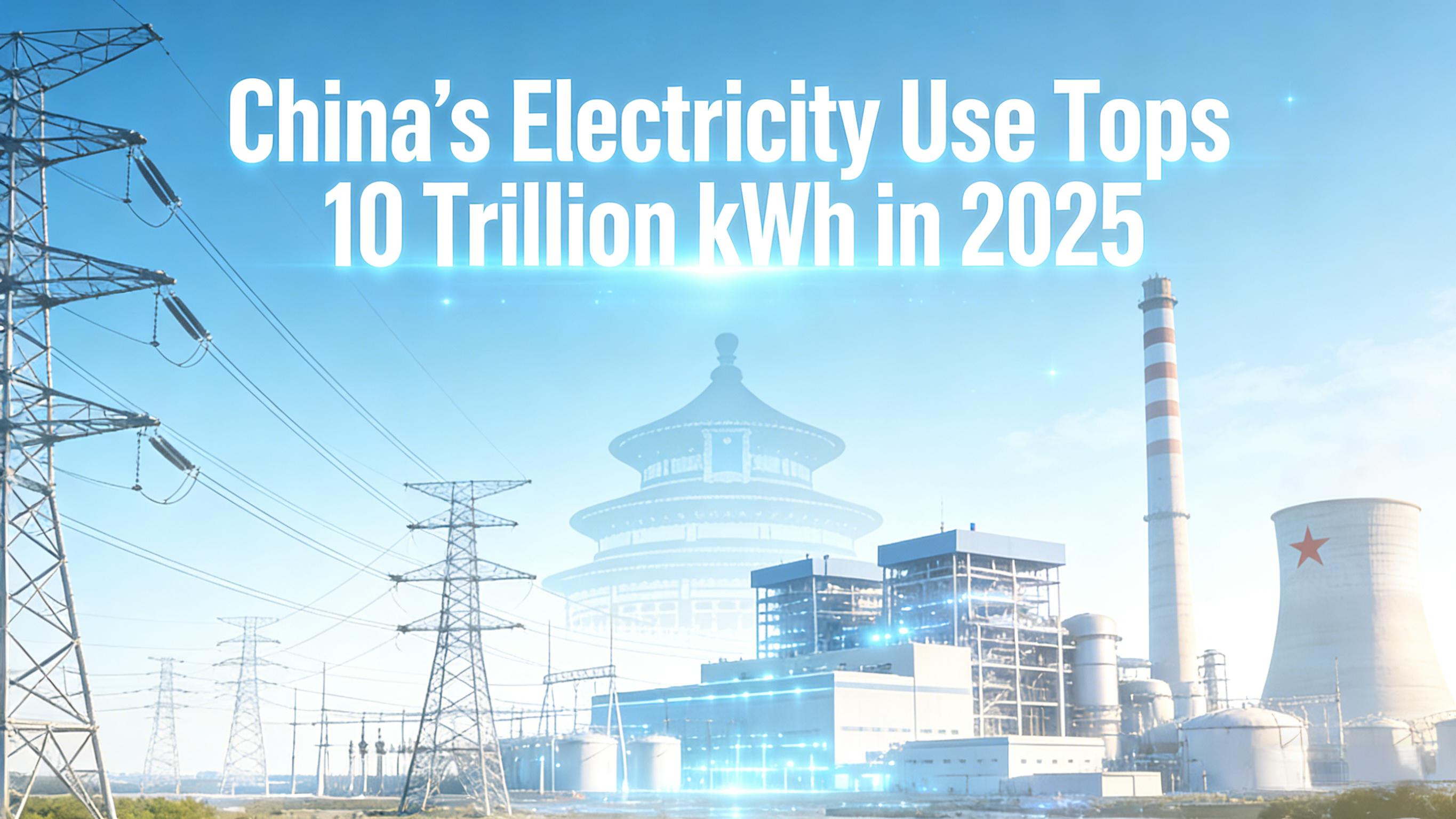
1.03682 trillion kilowatt-hours! The latest data released by the National Energy Administration shows that in 2025, China's total social electricity consumption exceeded 10 trillion kilowatt-hours for the first time, which is the first time in the world.
What is the scale of "10 trillion kilowatt-hours"? From a horizontal perspective, it is more than twice the total annual electricity consumption of the United States, and also higher than the sum of the annual electricity consumption of the European Union, Russia, India, and Japan. From a vertical comparison, China's electricity consumption exceeded 1 trillion kilowatt-hours for the first time in 1996, became the world's largest electricity-consuming country in 2011, fully solved the electricity problem for the population without access to electricity in 2015, and its electricity consumption in 2025 will be nearly twice that of 2015, with a growth rate unparalleled among the world's major economies.
Electricity consumption is regarded as a "barometer" and "weather vane" for the operation of the economy and society. Yang Kun, executive vice chairman of the China Electricity Council, believes that the first-time exceeding of 10 trillion kilowatt-hours in electricity consumption reflects the development foundation of China as a major manufacturing country and also demonstrates the comprehensive improvement of China's energy security capability.
The industrial structure is becoming new and optimized
The additional electricity consumption in industry comes more from high-value-added and technology-intensive industries.
In 2025, the electricity consumption of China's secondary industry was 6,636.6 billion kilowatt-hours, accounting for about 64% of the total social electricity consumption, and it remains the "basic foundation" of electricity consumption.
At the second phase project of Huahong Integrated Circuit in Wuxi, Jiangsu Province, the application of artificial intelligence and other factors have driven a surge in demand for semiconductor processing. "The production lines are operating continuously, and the shipment volume of wafers has increased significantly. In 2025, the company's electricity consumption increased by more than 43% year-on-year," said a relevant person in charge of Huahong Semiconductor Manufacturing (Wuxi) Co., Ltd.
Data from Jiangsu's electric power department shows that a landmark change has occurred in the electricity consumption structure of the local industrial sector. In 2025, the electricity consumption of the computer, communication, and other electronic equipment manufacturing industries exceeded 50 billion kilowatt-hours for the first time, surpassing traditional pillar industries such as steel and chemical engineering.
At Zhejiang Fubao Intelligent Technology Co., Ltd., technicians are upgrading and transforming intelligent elderly care robots. "We are accelerating the deployment of overseas markets, carrying out differentiated customized research and development, and have received multiple project orders from countries such as the UK, Germany, and France," said Ye Ting, the company's vice president. The company's electricity consumption has maintained rapid growth for 11 consecutive months, with a year-on-year increase of over 25% throughout last year.
Wang Gang, a senior engineer at the Energy Big Data Evaluation and Application Research Center of State Grid Hangzhou Power Supply Company, introduced that the rapidly developing artificial intelligence industry requires a large amount of computing power, which has driven a significant growth in electricity consumption. There are nearly 100 data centers operating in Hangzhou, Zhejiang Province, and their electricity consumption in 2025 increased by 47.2% year-on-year.
In 2025, the high-end, intelligent, and green development of industries made steady progress, with the structure continuously optimizing and upgrading. High-end manufacturing has formed new growth points in electricity consumption, with the growth rates of new energy vehicles and wind power equipment manufacturing exceeding 20% and 30% respectively. The electricity consumption growth rate of the four major high-energy-consuming industries was relatively low, increasing by 1.8%. "The leading role of 'new manufacturing' in industrial electricity consumption continues to strengthen, and the newly added electricity is more contributed by high-value-added and technology-intensive industries," said Yang Kun.
The upgraded service industry has also become an important engine driving electricity consumption. At the Huawei Cloud Data Center in Guian New Area, Guizhou, the server matrix operates around the clock. With the in-depth advancement of the "Eastern Data and Western Computing" project, the big data industry has become one of the fastest-growing areas in terms of electricity consumption in Guizhou.
In 2025, the electricity consumption of China's tertiary industry reached nearly 2 trillion kilowatt-hours, a year-on-year increase of 8.2%, accounting for approximately 19.2% of the total social electricity consumption. Nationwide, the electricity consumption of the charging and swapping service industry as well as the information transmission, software and information technology service industry grew by 48.8% and 17% respectively, with more newly added electricity flowing to new scenarios and new services.
Electrification development is more diversified
The electrification rate of terminal energy consumption is about 30%, and the gap in electricity consumption between urban and rural residents is gradually narrowing.
Currently, the electrification trend in China's energy production and consumption is evident, with the electrification rate of end-use energy reaching approximately 30%, which exceeds that of major developed economies and further drives the rise in electricity consumption.
Citrus cultivation and processing is one of the pillar industries in Xinping Yi and Dai Autonomous County, Yuxi, Yunnan. "Last year, we invested 20 million CNY to build a new intelligent micro-sprinkler irrigation system, which realizes automatic irrigation of the whole orchard, and the efficiency is about 65% higher than the traditional method," said Zhang Yueqiang, a staff member of the Technology Center of Xinping Chu's Agriculture Co., Ltd. To meet the electricity demand of characteristic agriculture, the local power department has built and transformed nearly 82 kilometers of 10-kilovolt lines and 69 distribution transformers, supporting the growth of electricity consumption in citrus cultivation and processing industry in Xinping County by more than 15% last year.
During the "14th Five-Year Plan" period, China implemented the rural power grid consolidation and upgrading project, with a cumulative central budgetary investment of 25 billion CNY, driving the total investment in rural power grids to exceed 800 billion CNY. In 2025, the gap in residential electricity consumption between urban and rural areas gradually narrowed.
The improvement in electrification levels is also reflected in changes in residents' lives. Take green travel as an example. In Shenzhen, Guangdong, the number of supercharging stations exceeds that of gas stations, and the electricity consumption of local charging and swapping services increased by 58.5% last year. In Chengdu, Sichuan, the total operating mileage of the rail transit network exceeds 750 kilometers, nearly one-third of the population in the central urban area takes the subway as their first choice for travel, and the electricity consumption of the subway in 2025 increased by about 160 million kilowatt-hours compared with the same period last year.
Across the country, rural electrification application scenarios such as electric irrigation and smart greenhouses are increasing. In the industrial sector, electricity substitution such as high-temperature heat pumps and electric heating is implemented. Energy supply models like "photovoltaic power generation + electric energy storage" are popularized in the construction sector. Ships and aircraft use shore power when berthing... The electrification of end-use energy is developing rapidly and diversely, promoting green production and life.
More and more green power supply
Adequate power sources, a strong power grid, and a vibrant market, setting multiple global records
During the peak summer electricity consumption period in 2025, the country's maximum electricity load hit a new high four times. The electricity consumption in July and August exceeded one trillion kilowatt-hours for two consecutive months, which was also the first time in the world. With electricity consumption repeatedly reaching new highs and the huge volume, where does the confidence in ensuring supply come from?
The world's largest power supply system and clean power generation system ensure power sources.
China's installed power generation capacity accounts for one-third of the world's total, and for every 3 kWh of electricity used, more than 1 kWh is green electricity. In 2025, the combined installed capacity of wind and photovoltaic power historically exceeded that of thermal power; the installed capacity of new energy storage exceeded the 100 million kW mark, accounting for more than 40% of the global total. These "giant power banks" have made wind and solar power generation more stable.
Over 95% of coal-fired power units have achieved ultra-low emissions, more than 50% of coal-fired power units are capable of deep peak regulation, and the world's largest clean coal power supply system has been built. During the "14th Five-Year Plan" period, projects such as the domestically-developed third-generation nuclear power technologies "HPR1000" and "Guohe-1", as well as the fourth-generation high-temperature gas-cooled reactors, have been completed and put into operation... Various types of power sources are being accelerated in construction and transformation, consolidating the basic foundation for ensuring power supply.
The world's largest and most complex power transmission and transformation project, a strong power grid.
On one end, there are massive power sources, and on the other end, thousands of households. The growth in electricity consumption is inseparable from the resource allocation and regulation of the power grid. In 2025, with the completion and operation of multiple UHV projects such as the Longdong-Shandong, Xinjiang Hami-Chongqing, Ningxia-Hunan, and Jinshang-Hubei projects, China has built 46 UHV projects. These projects "flash-deliver" the abundant clean energy from the western and northern regions to the load centers in the eastern and central regions, further consolidating the energy transmission network of "west-to-east power transmission" and "north-to-south power supply".
In 2025, State Grid completed fixed-asset investment exceeding 650 billion CNY; during the "14th Five-Year Plan" period, the cumulative fixed-asset investment exceeded 2.8 trillion CNY, both hitting record highs. In 2025, the electricity transmitted by China Southern Power Grid through the "West-to-East Power Transmission" project exceeded 260 billion kilowatt-hours for the first time, 31.1 billion kilowatt-hours more than in 2020, also setting a new historical high.
The world's largest "electricity supermarket" with a dynamic market.
During the peak summer electricity supply period in 2025, the southern region transmitted electricity to support Shanghai, Zhejiang, and Anhui for the first time. The Fujian-Guangdong interconnection operated at full power, with electricity volume increasing by 85% year-on-year. The afternoon peak of photovoltaic power generation in Xinjiang matched the evening peak of electricity consumption in Beijing and Tianjin, which not only realized the absorption of new energy in the west but also met the electricity supply guarantee needs in the east... The national unified electricity market is accelerating its construction, playing the role of a "regulator" for electricity resources and a "baton" for price guidance. Since the "14th Five-Year Plan" period, China's market-traded electricity volume has more than doubled from 10.7 trillion kilowatt-hours during the "13th Five-Year Plan" period to 23.8 trillion kilowatt-hours; its proportion in the total social electricity consumption has risen from 40% in 2020 to over 60% now.
The energy and power industry has provided strong energy and power support for China's modernization drive by actively building a new energy system, vigorously fostering new productive forces, continuously promoting green and low-carbon transformation, and advancing the high-quality leapfrog development of new and renewable energy," said Yang Kun.
10 trillion kilowatt-hours represents the continuous upgrading of power supply capacity, the transformation and optimization of China's economy, and even more the thriving of a better life.


